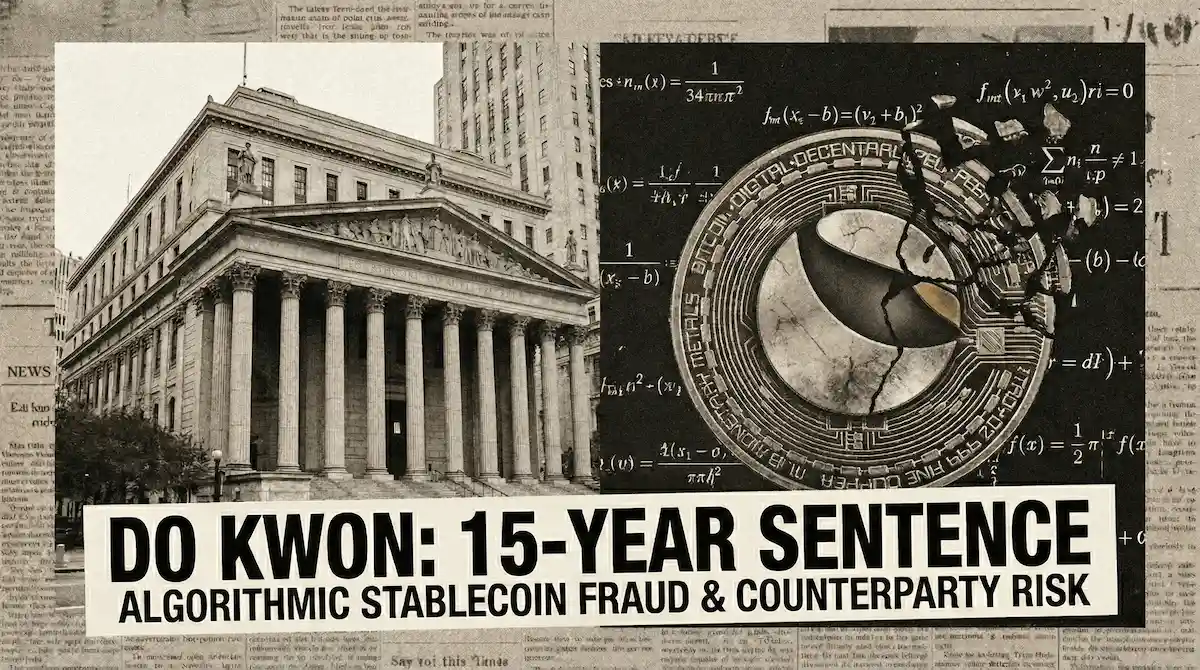
Do Kwon's 15-Year Sentence: What Algorithmic Stablecoin Fraud Means for Counterparty Risk
On 11 December 2025, Do Kwon received 15 years in federal prison for orchestrating the $40 billion Terra/UST collapse. This landmark verdict establishes that algorithmic stablecoin design failures combined with deliberate misrepresentation constitute federal crimes. For compliance officers, treasury managers, and wealth advisors, this fundamentally changes the due diligence calculus for stablecoin counterparty risk.
TL;DR
- •Do Kwon sentenced to 15 years in federal prison on 11 December 2025 for 'fraud of epic, generational scale' - the $40 billion Terra/UST collapse that triggered Three Arrows Capital, Celsius, and Voyager bankruptcies in 2022
- •Fraud proven on three counts: secretly arranging Jump Crypto to prop up UST while claiming algorithmic recovery, fabricating Chai payment processor transactions, and operating Anchor Protocol's 20% APY as unsustainable Ponzi-like structure with 75% of all UST concentrated
- •NBER research proves Terra's death spiral was mathematically predictable: when UST/LUNA market cap converged on 9 May 2022, the mint-burn mechanism created infinite dilution - sophisticated investors fled first (26-32% losses) while retail suffered 60-76% losses
- •GENIUS Act (signed July 2025) and MiCA now mandate 1:1 reserve backing, prohibit algorithmic mechanisms, require CEO/CFO personal certification with criminal penalties - creating explicit red flags compliance officers must identify
- •Key unknowns: Tether's full reserve composition despite S&P 'weak' rating, South Korean prosecution outcomes adding potential 40 years, synthetic stablecoin (Ethena USDe) regulatory classification under neither framework
No agenda. No noise. Just clarity.
Get the MCMS brief - digital assets, AI, and law explained with evidence, not hype.
Join 1,000+ professionals. Unsubscribe anytime.
Reader Navigation Guide
Jump to sections relevant to your role
Reader Navigation Guide
Jump to sections relevant to your role
| Reader Role | Relevant Sections |
|---|---|
| Legal & Compliance | Click to view sections →What Actually Happened — Three fraud schemes proven in court The Regulatory Response — GENIUS Act and MiCA frameworks Implications for Professional Practice — Updated compliance frameworks and red flags What We Still Don't Know — South Korean prosecution, Tether reserves |
| Corporate Treasury & Finance | Click to view sections →Who's Affected — Institutional victims and contagion map How Terra Failed — Death spiral mathematics and quantified fragility Compared to What — USDC transparency, Ethena stress tests Scenario Planning — Risk models for reserve and synthetic failures |
| Banking & Risk Management | Click to view sections →How Terra Failed — NBER research on death spiral mechanism Reserve-Backed Stablecoins — USDC vs Ethena architectures surviving stress What Could Still Go Wrong — Funding rate risk, exchange concentration Geographic Landscape — Strongest frameworks vs regulatory gaps |
| Family Offices & Allocators | Click to view sections →Institutional Victims — 3AC, Celsius, Voyager cascade Wealth Advisor Implications — Suitability obligations and risk disclosures Scenario Planning — Reserve failure vs bear market models |
| Fintech & Infrastructure | Click to view sections →Death Spiral Mechanism — Technical analysis of mint-burn fragility Surviving Architectures — USDC reserves, Ethena delta-neutral hedging Unresolved Risks — Proof-of-reserves limitations, synthetic classification |
| Policy & Regulatory Analysis | Click to view sections →The Fraud Behind Terra — Criminal case precedent established GENIUS Act and MiCA — Reserve requirements, issuer restrictions, penalties Geographic Landscape — Cross-border recognition and regulatory gaps What We Don't Know — Tether composition, synthetic classification |
This navigation framework is exclusive to MCMS members. Share this article to provide colleagues with the same analytical depth.
On 11 December 2025, U.S. District Judge Paul Engelmayer sentenced Terraform Labs founder Do Kwon to 15 years in federal prison for orchestrating what the court called "a fraud of an epic, generational scale" - the $40 billion Terra/UST collapse that triggered a cascade of institutional failures across the crypto ecosystem in 2022. This landmark conviction establishes concrete legal precedent: algorithmic stablecoinA cryptocurrency pegged to a stable asset, such as USD or gold design failures combined with deliberate misrepresentation constitute federal crimes carrying severe penalties.
For compliance officers evaluating stablecoinA cryptocurrency pegged to a stable asset, such as USD or gold counterparty risk, treasury managers holding digital asset reserves, and wealth advisors with client crypto exposure, this verdict fundamentally changes the due diligenceProcess of verifying customer identity and assessing risk calculus. The mechanisms that made Terra's failure mathematically inevitable - self-referential collateral, concealed manual interventions, unsustainable yield structures - are now explicit red flags that carry criminal liability for issuers and fiduciary exposure for institutions that fail to identify them.
What Actually Happened: The Fraud Behind Terra's Collapse
The criminal case against Do Kwon centred on systematic misrepresentations, not merely a failed algorithmic experiment. Prosecutors in the Southern District of New York proved three distinct fraud schemes that inflated Terraform's tokenA digital asset built on an existing blockchain, often representing utility or value values through deliberate deception.
The UST Peg Manipulation (May 2021)
When TerraUSD briefly lost its $1 peg, Kwon publicly attributed recovery to "algorithmic mechanisms" - the Terra Protocol automatically restoring stability. In reality, Kwon secretly arranged for Jump Crypto, a high-frequency trading firm, to purchase millions of dollars worth of UST to artificially prop up the price. This concealment was critical: it falsely demonstrated that the algorithmic system worked without external intervention, convincing investors that UST was fundamentally stable when it required manual bailouts.
The Chai Payment Processor Fraud
Kwon repeatedly claimed Terraform's blockchainA decentralized, digital ledger of transactions maintained across multiple computers processed billions in real-world transactionsA transfer of value or data recorded on a blockchain, verified by network participants, and permanently added to the distributed ledger through Chai, a Korean mobile payment application. Prosecutors proved Chai processed payments through traditional financial networks, not blockchain. Kwon created fake transactions replicated onto the Terraform blockchain to simulate activity. Internal messages revealed Kwon acknowledging: "I can just create fake transactions that look real which will generate fees."
Anchor Protocol's Unsustainable Yields
The Anchor ProtocolA defunct DeFi lending protocol on Terra that offered unsustainable 20% yields on UST deposits, concentrating 75% of all UST before the May 2022 collapse offered approximately 20% annual yields on UST deposits - economically unsustainable without constant capital inflows. Approximately 75% of all UST supply ($14 billion of $18.7 billion) concentrated in Anchor at collapse. This wasn't merely imprudent; prosecutors characterised it as a Ponzi-like structure where early depositors depended entirely on new capital to fund promised returns.
“"I knowingly agreed with others to engage in a scheme to defraud, and did in fact defraud, purchasers of the cryptocurrencies issued by my company." - Do Kwon, August 2025 guilty plea
Kwon pleaded guilty in August 2025 to conspiracy to defraud and wire fraud. Judge Engelmayer rejected both the prosecution's 12-year recommendation (as "unreasonably lenient") and defence's five-year request (as "utterly unthinkable"), imposing a 15-year sentence with lifetime ban on cryptocurrency industry participation.
Who's Affected: The Stakeholder Map for Institutional Risk Assessment
Institutional Victims and Contagion Targets
Terra's collapse didn't stay contained. The $40 billion evaporation triggered a cascade of failures that bankrupted major institutional players:
| Institution | Exposure | Outcome | Date |
|---|---|---|---|
| Three Arrows Capital (3AC) | Heavy UST/LUNA exposure | Chapter 15 bankruptcy, defaulted on hundreds of millions in loans | July 2022 |
| Celsius Network | $11+ billion in managed assets | Paused all withdrawals 12 June, Chapter 11 filed July | July 2022 |
| Voyager Digital | ~$650M frozen in 3AC estate | Chapter 11 bankruptcy | 5 July 2022 |
| Genesis Global | Direct Terra/3AC contagion | Bankruptcy filed January 2023 | January 2023 |
Genesis Global's interim CEO explicitly linked the collapse to Terra: "The collapse of Luna and UST and subsequent liquidation of 3AC signalled the onset of a new Crypto Winter."
Stakeholder Impact Assessment
Compliance Officers: The verdict establishes that algorithmic stablecoins without external collateral carry explicit fraud risk. Due diligenceProcess of verifying customer identity and assessing risk frameworks must now distinguish between reserve-backed mechanisms (USDCA fully-reserved stablecoin pegged 1:1 to the US Dollar, issued by Circle and backed by regulated financial institutions, USDTThe largest stablecoin by market cap, pegged 1:1 to the US Dollar and issued by Tether Limited) and self-referential designs where "collateral" consists of related tokens.
Treasury Managers: Any institution holding stablecoinA cryptocurrency pegged to a stable asset, such as USD or gold reserves faces fiduciary questions about counterparty assessment. The Terra verdict demonstrates that issuer representations about stabilisation mechanisms require independent verification - not acceptance of marketing claims.
Wealth Advisors: Client portfolios with digital asset exposure require updated risk disclosures. The 15-year sentence signals regulatory willingness to pursue individual accountability, meaning advisors recommending products with algorithmic stablecoinA cryptocurrency pegged to a stable asset, such as USD or gold exposure bear heightened suitability obligations.
Regulators: Judge Engelmayer explicitly rejected both lighter sentencing recommendations, establishing that crypto fraud sentencing will reflect systemic harm scale - $40 billion in losses affecting an estimated one million victims globally.
Timeline: From Launch to Prison
| Date | Event |
|---|---|
| 2018 | Terraform Labs founded; Do Kwon begins making representations about algorithmic stability |
| May 2021 | UST first depegs; Kwon secretly arranges Jump Crypto intervention while publicly claiming algorithmic recovery |
| May 2022 | UST/LUNA collapse; $40 billion destroyed in days; LUNA supply explodes from 342 million to 6.5 trillion tokens |
| July 2022 | Three Arrows Capital, Celsius, Voyager file bankruptcy in cascade |
| March 2023 | Kwon arrested in Montenegro with forged Costa Rican passport attempting to board flight to Dubai |
| April 2024 | SEC civil fraud trial verdict finds Terraform and Kwon liable |
| August 2025 | Kwon pleads guilty to federal conspiracy and wire fraud charges |
| 11 December 2025 | 15-year sentence imposed; lifetime ban on cryptocurrency industry participation |
How Terra Failed: The Mathematics of Inevitable Collapse
The National Bureau of Economic Research Working Paper No. 31160 "Anatomy of a Run: The Terra Luna Crash" (MIT/LSE, April 2023) provides the authoritative academic analysis proving Terra's fragility was mathematically predictable, not merely unfortunate.
The Death Spiral Mechanism
Terra's design relied on a mint-and-burn relationship between UST (stablecoinA cryptocurrency pegged to a stable asset, such as USD or gold) and LUNA (volatile counterpart). When UST traded below $1, users could burn 1 UST to mint $1 worth of LUNA, theoretically creating arbitrageBuying and selling an asset across different platforms to profit from price differences pressure to restore the peg.
The fatal flaw: this mechanism creates infinite LUNA supply under stress conditions.
The NBER paper models UST as "infinite maturity convertible debt with a face value of $1 backed by LUNA." When UST/LUNA market capitalisation converges - which occurred on 9 May 2022 - the system becomes unstable. Converting UST to LUNA dilutes existing LUNA holders; if investors expect significant LUNA price decline from dilution, "any LUNA holder would be better off selling LUNA ahead of the conversion resulting in a so-called death spiral of both UST and LUNA falling in tandem."
Quantified Fragility
- Anchor ProtocolA defunct DeFi lending protocol on Terra that offered unsustainable 20% yields on UST deposits, concentrating 75% of all UST before the May 2022 collapse required $6 million in daily subsidies by April 2022 to maintain 19.5% yields while net borrowing rates remained below lending rates
- The protocol concentrated 75% of all UST supply in a single point of failure
- Using blockchainA decentralized, digital ledger of transactions maintained across multiple computers data covering 7.5 million blocks and 228 million transactionsA transfer of value or data recorded on a blockchain, verified by network participants, and permanently added to the distributed ledger, MIT/LSE researchers proved sophisticated investors fled first: large holders withdrew 375 million UST on 7 May 2022, triggering the cascade
- Wealthy investors experienced 26-32% losses versus 60-76% for retail investors who "attempted to buy into the run, hoping to buy the dipStrategy of buying assets during price declines, often exploited in dump phases"
“"Algorithmic stablecoins are less stable than their issuers claim and susceptible to de-pegging in the event of a large shock that becomes self-perpetuating once it starts." - Bank for International SettlementsInternational financial institution serving central banks and fostering monetary and financial cooperation, 2022 Annual Economic Report
The Federal Reserve's FEDS Paper 2023-044 documented Terra's "vicious dependence" on Anchor ProtocolA defunct DeFi lending protocol on Terra that offered unsustainable 20% yields on UST deposits, concentrating 75% of all UST before the May 2022 collapse and tracked how the collapse triggered $450 billion in total crypto value destruction.
Compared to What: Reserve-Backed Stablecoins and Surviving Stress Tests
USDC (Circle): The Transparency Standard
Circle maintains 100% reserves in identifiable, liquid assets:
- February 2025 attestation: $54.3 billion USDCA fully-reserved stablecoin pegged 1:1 to the US Dollar, issued by Circle and backed by regulated financial institutions in circulation; $54.6 billion in reserves (overcollateralised)
- Reserve composition: $48.26 billion in short-term U.S. Treasury bills; $6.93 billion in cash at regulated institutions
- Independent verification: Grant Thornton LLP conducts monthly independent attestations under AT-C 205 (AICPA Attestation Standards)
Why this architecture survives stress: No mint-burn mechanism with volatile counterpart; no dilution risk; external value anchorA defunct DeFi lending protocol on Terra that offered unsustainable 20% yields on UST deposits, concentrating 75% of all UST before the May 2022 collapse backed by U.S. government obligations rather than self-referential tokenA digital asset built on an existing blockchain, often representing utility or value relationships.
Ethena USDe: Stress-Tested Synthetic Design
Ethena's USDeA crypto-backed synthetic dollar stablecoin issued by Ethena Labs that tracks the US dollar without relying on bank-held fiat reserves faced its most severe test on 11 October 2025 during a $19 billion crypto liquidation cascade. BitcoinThe first decentralized cryptocurrency, created in 2009 by Satoshi Nakamoto plummeted 13.2%; EthereumA decentralized blockchain platform that enables smart contracts and decentralized applications crashed 16%. USDe briefly dropped to $0.65 on Binance, but this was an exchangeA platform where users can buy, sell, or trade cryptocurrencies-specific liquidityThe ease with which an asset can be bought or sold without affecting its price crisis, not systemic protocol failure.
Critical distinction from Terra: USDeA crypto-backed synthetic dollar stablecoin issued by Ethena Labs that tracks the US dollar without relying on bank-held fiat reserves remained overcollateralised by approximately $66 million throughout the crisis. The delta-neutral hedging mechanism continued functioning - Ethena's short positions generated $120 million in floating profits from ETHA decentralized blockchain platform that enables smart contracts and decentralized applications's decline. Redemptions processed at $1 parity through official channels with zero downtime. USDe supply contracted from $14.2 billion to $12.6 billion as institutional actors redeemed normally.
The Regulatory Response: GENIUS Act and MiCA Frameworks
United States: GENIUS Act (Signed July 2025)
The Guaranteeing Essential Regulatory Oversight for New and Innovative Stablecoins Act establishes the first comprehensive federal framework with explicit Terra-prevention mechanisms.
Reserve Requirements mandate 1:1 backing with permitted assets only:
- U.S. dollars, Federal Reserve notes, FDIC-insured deposits
- Short-term Treasury securities, Treasury-backed reverse repos
- Regulated money market funds
- Explicit prohibition on commercial paper, algorithmic mechanisms, and volatile crypto assets as primary reserves
Issuer Restrictions limit issuance to:
- FDIC-insured depository institutions
- Credit unions
- Bank subsidiaries
- State trust companies (under $10 billion)
- Federal Reserve-approved nonbank financial institutions (over $10 billion)
Accountability provisions:
- Monthly attestations by Big Four accounting firms
- CEO and CFO must personally certify reserve accuracy
- Up to 5 years imprisonment and $1 million fines for willful violations, knowing fraud, or false statements
Structural Protections:
- No interest or yield payments to stablecoinA cryptocurrency pegged to a stable asset, such as USD or gold holders (blocking AnchorA defunct DeFi lending protocol on Terra that offered unsustainable 20% yields on UST deposits, concentrating 75% of all UST before the May 2022 collapse-style Ponzi structures)
- Reserves are not property of issuer's bankruptcy estate
- StablecoinA cryptocurrency pegged to a stable asset, such as USD or gold holders have super-priority claims in insolvency
European Union: MiCA (Effective June 2024)
Markets in Crypto-AssetsAn EU regulatory framework standardizing crypto rules for issuers and service providers Regulation requires:
- 1:1 backing with liquid, low-risk assets
- Asset segregationLegal and operational separation of client crypto-assets from service provider's own holdings from issuer operational funds
- Monthly public reporting to national supervisory authorities
- Independent audits
- Algorithmic designs cannot qualify as "regulated stablecoins" under MiCAAn EU regulatory framework standardizing crypto rules for issuers and service providers
Key difference from GENIUS: MiCAAn EU regulatory framework standardizing crypto rules for issuers and service providers mandates at least 30% of EMT reserves held as deposits in EU credit institutions, reintroducing bank credit risk that GENIUS explicitly avoids by prohibiting longer-maturity bonds and bank deposit requirements.
Japan: Payment Services Act (Effective June 2023)
Only banks, funds transfer service providers, and licensed trust companies may issue stablecoins. 2025 amendments permit up to 50% of reserves in low-risk assets (government bonds, redeemable term deposits), with regulatory authority to mandate domestic asset retention during stress.
What Could Still Go Wrong: Barriers and Unresolved Risks
The new regulatory frameworks address Terra's specific failures but leave gaps.
Negative Funding Rate Risk affects synthetic stablecoins: Ethena's USDeA crypto-backed synthetic dollar stablecoin issued by Ethena Labs that tracks the US dollar without relying on bank-held fiat reserves survives on positive perpetual futures funding rates. When crypto markets turn bearish, funding can flip negative - Ethena must pay to maintain short positions rather than earning yield. Extended bear markets stress the business model even if collateral remains intact.
ExchangeA platform where users can buy, sell, or trade cryptocurrencies Counterparty Concentration persists: Despite off-exchange custody improvements, synthetic stablecoins maintain margin positions across centralised exchanges. Exchange failure creates direct exposure - a risk the October 2025 Binance liquidityThe ease with which an asset can be bought or sold without affecting its price crisis briefly illustrated.
Jurisdictional ArbitrageBuying and selling an asset across different platforms to profit from price differences continues: GENIUS and MiCAAn EU regulatory framework standardizing crypto rules for issuers and service providers converge on transparency and reserve requirements, but neither framework addresses stablecoins operating outside regulated jurisdictions. TetherThe largest stablecoin by market cap, pegged 1:1 to the US Dollar and issued by Tether Limited (USDT), the largest stablecoinA cryptocurrency pegged to a stable asset, such as USD or gold at $184 billion, operates from El Salvador and the British Virgin Islands, outside direct GENIUS or MiCA supervision.
Proof-of-Reserves Limitations remain: CryptographicThe science of encoding and decoding information, used to secure cryptocurrency transactions attestation systems verify reserves at point-in-time snapshots. They don't capture intraday leverage, rehypothecation between snapshots, or off-balance-sheet commitments. Monthly attestations improve transparency but don't eliminate window-dressing risk.
Geographic Landscape: Where Regulatory Clarity Exists
Strongest Frameworks:
- United States (GENIUS ActUS law (July 2025) requiring payment stablecoin issuers to be regulated entities with 1:1 reserve backing)
- European Union (MiCAAn EU regulatory framework standardizing crypto rules for issuers and service providers)
- Japan (Payment Services Act amendments)
- Singapore (MAS Payment Services Act)
Regulatory Gaps:
- Offshore jurisdictions (BVI, Cayman, El Salvador) continue hosting major stablecoinA cryptocurrency pegged to a stable asset, such as USD or gold operations outside comprehensive frameworks
- TetherThe largest stablecoin by market cap, pegged 1:1 to the US Dollar and issued by Tether Limited's registration in El Salvador specifically positions it outside U.S. and EU regulatory reach
Cross-Border Recognition:
- GENIUS ActUS law (July 2025) requiring payment stablecoin issuers to be regulated entities with 1:1 reserve backing empowers Treasury to pursue regulatory passportingRight to offer crypto services across EU member states with home state authorization with comparable jurisdictions
- The World Economic Forum notes: "This opens the door for US-regulated issuers to expand internationally with the backing of a home-court regulator, while international issuers from credible jurisdictions with substantially similar regimes, like the EU, may gain continued access to US markets."
- MiCAAn EU regulatory framework standardizing crypto rules for issuers and service providers requires foreign entities to establish EU subsidiaries for market access - no passportingRight to offer crypto services across EU member states with home state authorization from non-EU jurisdictions regardless of home-country framework quality
Scenario Planning: What Institutional Risk Managers Should Model
Scenario 1: Major Reserve-Backed StablecoinA cryptocurrency pegged to a stable asset, such as USD or gold Issuer Failure
Unlike Terra, reserve-backed stablecoinA cryptocurrency pegged to a stable asset, such as USD or gold failures would involve actual asset recovery. GENIUS ActUS law (July 2025) requiring payment stablecoin issuers to be regulated entities with 1:1 reserve backing bankruptcy protections create super-priority claims on segregated reserves. Model impact: redemption delays (days to weeks), potential haircuts if reserves prove less liquid than attested, but no death-spiral dynamics.
Scenario 2: Extended Crypto Bear Market
Synthetic stablecoins (Ethena model) face margin pressure if funding rates remain negative for extended periods. Model impact: yield compression, potential supply contraction as redemptions exceed minting, but collateral remains recoverable unlike algorithmic designs.
Scenario 3: ExchangeA platform where users can buy, sell, or trade cryptocurrencies Cascade Failure
Centralised exchangeA platform where users can buy, sell, or trade cryptocurrencies concentration creates correlated counterparty risk across multiple stablecoinA cryptocurrency pegged to a stable asset, such as USD or gold architectures. Model impact: temporary liquidityThe ease with which an asset can be bought or sold without affecting its price dislocations (October 2025 demonstrated this), potential trapped margin for synthetic designs, but reserve-backed stablecoins with bank custody maintain redemption functionality.
Implications for Professional Practice
For Compliance Officers
Update counterparty risk frameworks to distinguish between:
- Reserve-backed stablecoins with independent attestation (lower risk)
- Synthetic stablecoins with real collateral but exchangeA platform where users can buy, sell, or trade cryptocurrencies exposure (moderate risk)
- Algorithmic designs with self-referential collateral (unacceptable risk under new regulatory standards)
The Terra verdict establishes that failure to identify algorithmic fraud mechanisms may constitute inadequate due diligenceProcess of verifying customer identity and assessing risk.
For Treasury Managers
Require independent reserve verification before approving stablecoinA cryptocurrency pegged to a stable asset, such as USD or gold counterparty exposure. Monthly attestations from Big Four firms under GENIUS ActUS law (July 2025) requiring payment stablecoin issuers to be regulated entities with 1:1 reserve backing or equivalent MiCAAn EU regulatory framework standardizing crypto rules for issuers and service providers requirements should become minimum standards. Diversify stablecoin holdings across issuers and architectures to avoid concentration risk demonstrated by Anchor ProtocolA defunct DeFi lending protocol on Terra that offered unsustainable 20% yields on UST deposits, concentrating 75% of all UST before the May 2022 collapse's 75% UST capture.
For Wealth Advisors
Client suitability assessments for crypto-exposed portfolios must now address stablecoinA cryptocurrency pegged to a stable asset, such as USD or gold counterparty quality explicitly. The 15-year sentence for Do Kwon, combined with Sam Bankman-Fried's 25 years, establishes that US regulatory authorities will pursue individual accountability aggressively. Recommending products with inadequately collateralised stablecoin exposure carries heightened liability.
“"The sentence reflects the enormity of the harm Do Kwon caused. His criminal conduct devastated the crypto ecosystem and wiped out the savings of countless individuals." - U.S. Attorney Damian Williams, Southern District of New York
What We Still Don't Know
TetherThe largest stablecoin by market cap, pegged 1:1 to the US Dollar and issued by Tether Limited's Full Reserve Composition: Despite quarterly BDO Italia attestations showing $5.6 billion in excess reserves, S&P Global downgraded USDT to "5 (weak)" in November 2025, citing increased high-risk assets (24% versus 17% year prior) and "disclosure deficiencies." The largest stablecoinA cryptocurrency pegged to a stable asset, such as USD or gold by market capitalisation lacks the transparency granularity GENIUS ActUS law (July 2025) requiring payment stablecoin issuers to be regulated entities with 1:1 reserve backing will require of regulated issuers.
South Korean Prosecution Outcomes: Kwon faces potential additional charges in South Korea that could add up to 40 years to his sentence. Extradition decisions and Korean court proceedings remain pending - outcomes that will establish whether U.S. sentencing represents the floor or ceiling for Terra-related liability.
Synthetic StablecoinA cryptocurrency pegged to a stable asset, such as USD or gold Regulatory Classification: Neither GENIUS ActUS law (July 2025) requiring payment stablecoin issuers to be regulated entities with 1:1 reserve backing nor MiCAAn EU regulatory framework standardizing crypto rules for issuers and service providers explicitly addresses delta-neutral synthetic designs like Ethena's USDeA crypto-backed synthetic dollar stablecoin issued by Ethena Labs that tracks the US dollar without relying on bank-held fiat reserves. Whether these architectures qualify as "regulated stablecoins" under either framework remains unresolved, creating classification uncertainty for institutional adopters.
The Bottom Line
Do Kwon's 15-year sentence transforms stablecoinA cryptocurrency pegged to a stable asset, such as USD or gold counterparty assessment from best practice to documented fiduciary obligation. The mechanisms proven as fraud - self-referential collateral, concealed interventions, unsustainable yields - are now explicit red flags with criminal precedent.
For institutions evaluating stablecoinA cryptocurrency pegged to a stable asset, such as USD or gold exposure, the calculus has changed. Reserve-backed stablecoins with independent attestation (USDCA fully-reserved stablecoin pegged 1:1 to the US Dollar, issued by Circle and backed by regulated financial institutions model) carry fundamentally different risk profiles than algorithmic designs or opaque reserve structures. GENIUS ActUS law (July 2025) requiring payment stablecoin issuers to be regulated entities with 1:1 reserve backing's CEO/CFO personal certification requirement with criminal penalties creates accountability chains that didn't exist before July 2025.
The $40 billion lesson has been litigated, sentenced, and codified into law. The question for compliance officers, treasury managers, and wealth advisors is whether their frameworks reflect what we now know - or what issuers claimed before the collapse.
Up Next
The Terra verdict establishes criminal liability for algorithmic stablecoinA cryptocurrency pegged to a stable asset, such as USD or gold fraud. But the regulatory response creates new questions: How will GENIUS ActUS law (July 2025) requiring payment stablecoin issuers to be regulated entities with 1:1 reserve backing's "comparable regime" determinations affect offshore stablecoin access? What happens to synthetic designs like Ethena's USDeA crypto-backed synthetic dollar stablecoin issued by Ethena Labs that tracks the US dollar without relying on bank-held fiat reserves that don't fit neatly into either reserve-backed or algorithmic categories?
Coming next: How the GENIUS ActUS law (July 2025) requiring payment stablecoin issuers to be regulated entities with 1:1 reserve backing is reshaping the competitive landscape for stablecoinA cryptocurrency pegged to a stable asset, such as USD or gold issuers, with detailed analysis of which players are positioning for compliance and which face restricted U.S. market access.
If you read this far, you're already ahead of most professionals.
Join 1,000+ readers who get institutional-grade insights - clear, concise, and verifiable.
No spam. Unsubscribe anytime.
If you found this useful, please share it.
Questions or feedback? Contact us
MCMS Brief • Classification: Public • Sector: Digital Assets • Region: Global
References
- 1. U.S. Department of Justice - “Crypto-Enabled Fraudster Sentenced for Orchestrating $40 Billion Fraud” (December 11, 2025) [Link]
- 2. U.S. Securities and Exchange Commission - “Terraform Labs Amended Complaint” (January 1, 2024) [Link]
- 3. U.S. Securities and Exchange Commission - “SEC Terraform Labs Civil Fraud Press Release” (January 1, 2024) [Link]
- 4. The New York Times - “Crypto Mogul Do Kwon Sentenced to 15 Years for Fraud” (December 11, 2025) [Link]
- 5. Bloomberg - “Do Kwon Gets 15 Years in Prison for $40 Billion Terraform Fraud” (December 11, 2025) [Link]
- 6. Bloomberg - “How Crypto Hedge Fund Three Arrows Fell Apart” (July 13, 2022) [Link]
- 7. BBC - “Do Kwon Sentenced to 15 Years” (December 11, 2025) [Link]
- 8. CNBC - “TerraUSD Creator Do Kwon Sentenced to 15 Years” (December 12, 2025) [Link]
- 9. CNBC - “Terraform Labs and Do Kwon Found Liable in Civil Fraud Trial” (April 5, 2024) [Link]
- 10. CNN - “Cryptocurrency mogul Do Kwon sentenced for fraud” (December 11, 2025) [Link]
- 11. Reuters - “Crypto Hedge Fund Three Arrows Files Chapter 15 Bankruptcy” (July 1, 2022) [Link]
- 12. Reuters - “Crypto Lender Celsius Files Bankruptcy” (July 14, 2022) [Link]
- 13. Reuters - “Tether Stablecoin Downgraded to Weak by S&P” (November 26, 2025) [Link]
- 14. National Bureau of Economic Research - “Anatomy of a Run: The Terra Luna Crash” (April 1, 2023) [Link]
- 15. Seoul National University - “The Terra Luna Collapse and the Role of the Anchor Protocol” (January 1, 2024) [Link]
- 16. World Economic Forum - “US GENIUS Act and EU MiCA Convergence” (September 1, 2025) [Link]
- 17. Georgetown International Law Journal - “The GENIUS Act Analysis” (January 1, 2025) [Link]
- 18. Oxford Academic Journal of International Economic Law - “Stablecoin Regulation Under GENIUS Act and MiCA” (January 1, 2025) [Link]
- 19. Circle / Grant Thornton - “USDC Attestation Report February 2025” (February 1, 2025) [Link]
- 20. New York Attorney General - “Galaxy Digital Assurance of Discontinuance” (January 1, 2025) [Link]
SOURCE FILES
Source Files expand the factual layer beneath each MCMS Brief — the verified data, primary reports, and legal records that make the story real.
The Criminal Case: Three Fraud Schemes Proven
The U.S. Department of Justice's Southern District of New York prosecution established three fraud counts. First, the May 2021 UST depeg recovery was publicly attributed to 'algorithmic mechanisms' when Kwon secretly arranged Jump Crypto to purchase millions in UST to prop up the price. This concealment falsely demonstrated algorithmic stability to investors. Second, Kwon repeatedly claimed Terraform's blockchain processed billions through Chai, a Korean mobile payment app. Prosecutors proved Chai processed payments through traditional networks, not blockchain. Internal messages revealed Kwon acknowledging he could 'create fake transactions that look real which will generate fees.' Third, Anchor Protocol's 20% APY was economically unsustainable without constant capital inflows. Approximately 75% of all UST supply ($14 billion of $18.7 billion) concentrated in Anchor at collapse. The DOJ characterized this as a Ponzi-like structure. Kwon pleaded guilty in August 2025, admitting: 'I knowingly agreed with others to engage in a scheme to defraud, and did in fact defraud, purchasers of the cryptocurrencies issued by my company.' Judge Engelmayer sentenced him to 15 years, rejecting both prosecution's 12-year recommendation (as 'unreasonably lenient') and defense's 5-year request (as 'utterly unthinkable').
Institutional Contagion: The Cascade Effect
The contagion pattern is now well-documented. Three Arrows Capital (3AC), a crypto hedge fund with heavy UST and LUNA exposure, defaulted on hundreds of millions in loan payments and filed bankruptcy in July 2022. The firm's collapse exposed concentrated counterparty risk across the industry. Celsius Network, managing over $11 billion in assets, paused all withdrawals on 12 June 2022 and filed Chapter 11 the following month. Voyager Digital filed Chapter 11 on 5 July 2022, citing approximately $650 million frozen in the 3AC estate. Genesis Global filed bankruptcy in January 2023, with its interim CEO explicitly linking the collapse to Terra: 'The collapse of Luna and UST and subsequent liquidation of 3AC signalled the onset of a new Crypto Winter.' The NBER Working Paper 31160 (MIT/LSE) documented how sophisticated investors experienced 26-32% losses versus 60-76% for retail investors who 'attempted to buy into the run, hoping to buy the dip.' The paper tracked 7.5 million blocks and 228 million transactions, proving large holders withdrew 375 million UST on 7 May 2022, triggering the cascade.
The Death Spiral Mathematics
The NBER Working Paper 31160 'Anatomy of a Run: The Terra Luna Crash' provides authoritative academic analysis. The paper models UST as 'infinite maturity convertible debt with a face value of $1 backed by LUNA.' The mint-burn mechanism allowed users to burn 1 UST to mint $1 worth of LUNA when UST traded below $1. The fatal flaw: this creates infinite LUNA supply under stress. When investors expect significant LUNA price decline from dilution, 'any LUNA holder would be better off selling LUNA ahead of the conversion resulting in a so-called death spiral of both UST and LUNA falling in tandem.' When UST/LUNA market capitalization converged on 9 May 2022, the system became unstable. Anchor Protocol required $6 million in daily subsidies by April 2022 to maintain 19.5% yields while net borrowing rates remained below lending rates. LUNA supply exploded from 342 million to 6.5 trillion tokens during the collapse. The Bank for International Settlements confirmed in its 2022 Annual Economic Report that algorithmic stablecoins are 'less stable than their issuers claim' and 'susceptible to de-pegging in the event of a large shock that becomes self-perpetuating once it starts.'
Regulatory Response: GENIUS Act and MiCA Frameworks
The GENIUS Act establishes federal stablecoin licensing with reserve requirements mandating 1:1 backing with permitted assets: U.S. dollars, Federal Reserve notes, FDIC-insured deposits, short-term Treasury securities, Treasury-backed reverse repos, and regulated money market funds. Commercial paper, algorithmic mechanisms, and volatile crypto assets are explicitly prohibited as primary reserves. Accountability provisions require monthly attestations by Big Four accounting firms with CEO and CFO personal certification of reserve accuracy. Willful violations, knowing fraud, or false statements carry up to 5 years imprisonment and $1 million fines. Reserves are not property of issuer's bankruptcy estate, and stablecoin holders have super-priority claims in insolvency. MiCA requires 1:1 backing with liquid, low-risk assets, asset segregation from issuer operational funds, monthly public reporting, and independent audits. Algorithmic designs cannot qualify as 'regulated stablecoins' under MiCA. The World Economic Forum notes convergence between frameworks, with Treasury empowered to pursue regulatory passporting with comparable jurisdictions.
Reserve-Backed Stablecoin Stress Tests
Circle's USDC maintains 100% reserves in identifiable, liquid assets. February 2025 attestation showed $54.3 billion USDC in circulation with $54.6 billion in reserves (overcollateralized). Reserve composition: $48.26 billion in short-term U.S. Treasury bills and $6.93 billion in cash at regulated institutions. Grant Thornton LLP conducts monthly independent attestations under AT-C 205 standards. Ethena's USDe faced its most severe test on 11 October 2025 during a $19 billion crypto liquidation cascade. Bitcoin plummeted 13.2%; Ethereum crashed 16%. USDe briefly dropped to $0.65 on Binance, but this was exchange-specific liquidity crisis, not systemic protocol failure. Critical distinction from Terra: USDe remained overcollateralized by approximately $66 million throughout. The delta-neutral hedging mechanism continued functioning with Ethena's short positions generating $120 million in floating profits. Redemptions processed at $1 parity through official channels with zero downtime. In contrast, Tether's USDT received S&P Global downgrade to '5 (weak)' in November 2025, citing increased high-risk assets (24% versus 17% year prior) and 'disclosure deficiencies.'
KEY SOURCE INDEX
- ●BBC — International news coverage of Do Kwon's 15-year federal prison sentence
- ●Bloomberg — Financial news coverage of sentencing and Three Arrows Capital collapse analysis
- ●Circle / Grant Thornton — USDC issuer attestation report showing $54.6 billion in reserves under AT-C 205 standards
- ●CNBC — Financial news coverage of Terra collapse, civil fraud trial verdict, and sentencing
- ●CNN — International news coverage of Do Kwon fraud sentencing and institutional impact
- ●Georgetown International Law Journal — Legal analysis of GENIUS Act framework and stablecoin licensing requirements
- ●National Bureau of Economic Research — MIT/LSE academic research proving Terra's death spiral was mathematically predictable using 7.5 million blocks and 228 million transactions
- ●New York Attorney General — Galaxy Digital assurance of discontinuance related to Terra/LUNA promotion
- ●New York Times — Primary news coverage of Do Kwon sentencing as 'fraud of epic, generational scale'
- ●Oxford Academic — Journal of International Economic Law analysis of stablecoin regulation under GENIUS Act and MiCA
- ●Reuters — Financial news coverage of Three Arrows/Celsius bankruptcies and Tether S&P downgrade to 'weak'
- ●Seoul National University — Academic analysis of Terra Luna collapse and Anchor Protocol's role in concentrating systemic risk
- ●U.S. Department of Justice — Official federal prosecution announcement of Do Kwon's 15-year sentence for orchestrating $40 billion fraud
- ●U.S. Securities and Exchange Commission — Civil fraud case against Terraform Labs with amended complaint documenting fraud schemes
- ●World Economic Forum — Analysis of GENIUS Act and MiCA regulatory convergence and cross-border stablecoin frameworks
Related Reading
- →
The $40B Collapse That Changed Crypto Forever
How the collapse of Terra's UST reshaped the conversation around stablecoins, trust, and the future of digital currencies.
- →
GENIUS Act Stablecoin Non-US Entity Impact
Three months after the GENIUS Act became law, the stablecoin reshuffle is underway. Circle and Paxos are executing compliance strategies. Tether launched USAT for U.S. markets. DAI remains in regulatory limbo. Here's the breakdown of who's in, who's out, and what it means for institutions navigating the $300B+ stablecoin market.
- →
Is JPYC MiCA Compliant?
JPYC delivers 12-second settlement and near-zero fees for Japan-ASEAN trade, saving ¥20-80 billion annually on unnecessary FX friction. Yet Stellantis, Ford, and every major multinational are legally barred from using it - MiCA blocks EU entities, GENIUS Act blocks Americans, and banking relationships punish defectors. The only winners: mid-sized Japanese exporters and ASEAN grey-zone operators navigating jurisdictional arbitrage.
- →
Stablecoins vs CBDCs vs Tokenized Deposits
A comprehensive comparison of stablecoins, CBDCs, and tokenized deposits - examining regulatory frameworks, risk profiles, and institutional use cases for cross-border payments, settlement, and liquidity management.
- →
GENIUS Act Stablecoin Landscape Analysis
Three months after the GENIUS Act became law, the stablecoin landscape is being reshaped. Circle aims for federal licensing, Tether pivots to U.S.-compliant USAT, and DAI sits outside the perimeter. Here's how major stablecoins are positioning for regulatory compliance—and who's likely to survive the cut.
Tags
Disclaimer: This content is for educational and informational purposes only. It is NOT financial, investment, or legal advice. Cryptocurrency investments carry significant risk. Always consult qualified professionals before making any investment decisions. Make Crypto Make Sense assumes no liability for any financial losses resulting from the use of this information. Full Terms