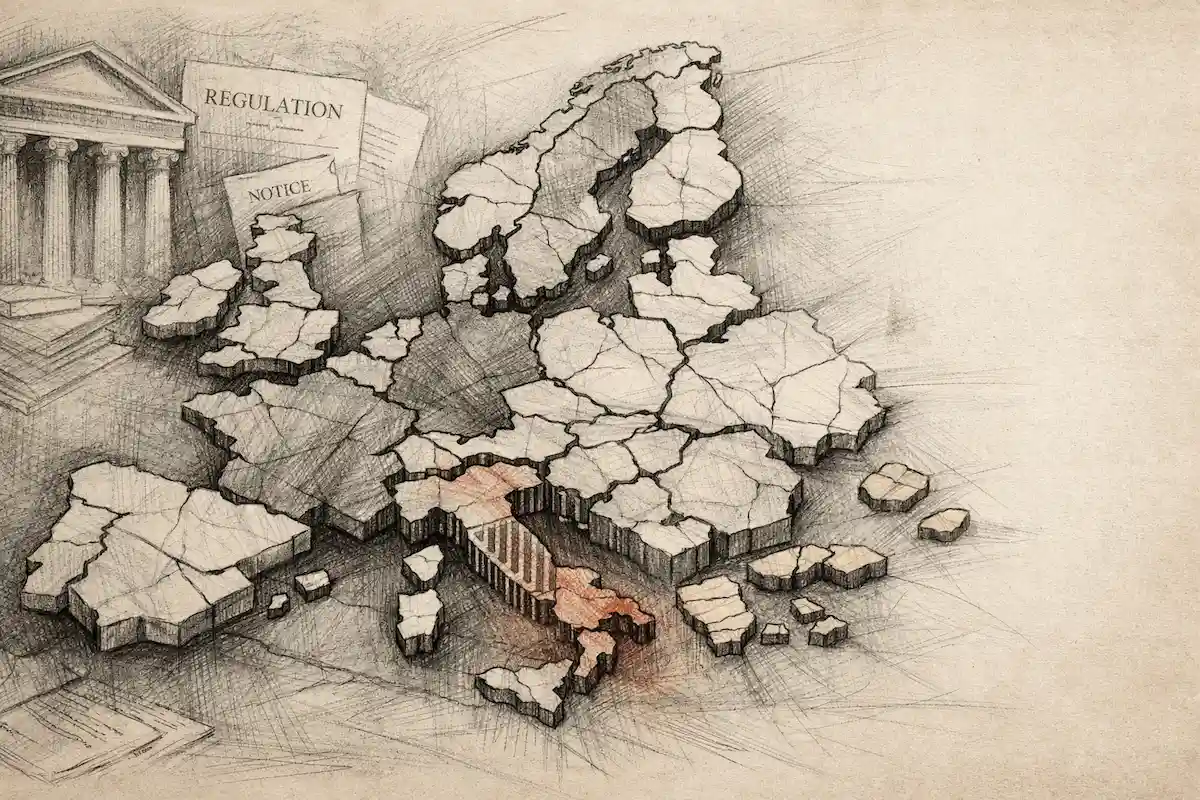
MiCA's Passport Problem: Europe's Crypto Single Market Is Fracturing Before It Begins
MiCA promised one license for 27 countries. Reality: Italy imposes up to 4-year prison terms for unlicensed crypto activity while Malta fast-tracks approvals. Poland requires local directors for substantial business. The EU's unified crypto framework faces implementation friction - though passporting works, national enforcement varies significantly.
TL;DR
- •MiCA's passport mechanism enables one license for 27 EU markets, but national enforcement divergence creates implementation friction - Italy's criminal penalties (up to 4 years) for unlicensed activity vs Malta's streamlined approvals illustrates the variance
- •Criminal liability: Italy enacted Legislative Decree 129/2024 with 6 months to 4 years imprisonment for unauthorized CASP services. Poland and Germany require local directors for substantial business. These requirements apply to firms with significant local presence, not all passported entities
- •Transition period: Article 143 allows nationally-authorized firms to continue operating domestically until July 2026. Note: grandfathered VASPs cannot passport during transition - only MiCA-authorized firms gain full passport rights
- •Passporting works for market access. However, firms targeting substantial business in specific markets may face local substance requirements: resident directors (Poland, Germany for significant operations), local compliance oversight, and varying AML standards
No agenda. No noise. Just clarity.
Get the MCMS brief - digital assets, AI, and law explained with evidence, not hype.
Join 1,000+ professionals. Unsubscribe anytime.
Reader Navigation Guide
Jump to sections relevant to your role
Reader Navigation Guide
Jump to sections relevant to your role
| Reader Role | Relevant Sections |
|---|---|
| Legal & Compliance | Click to view sectionsCriminal Liability Fragmentation - Italy's 4-year terms, Poland's local requirements The Passport Promise - Article 59 mechanism vs reality Local Substance Requirements - Director residency, physical presence rules |
| Corporate Treasury & Finance | Click to view sectionsCompliance Cost Reality - EUR 200-700K annual for pan-EU operation Strategic Pathways - Hub-and-spoke vs local entity approaches Transition Period Arbitrage - Grandfathering provisions until July 2026 |
| Banking & Risk Management | Click to view sectionsCriminal Liability Exposure - Cross-border prosecution risks AML Enforcement Divergence - National FIU discretion Stablecoin Issuer Requirements - Reserve and custody standards |
| Policy & Regulatory Analysis | Click to view sectionsSingle Market Theory - MiCA's design vs implementation Enforcement Matrix - 27 approaches to one regulation Three Scenarios Forward - Fortress Europe, ESMA pushback, UK alternative |
| Fintech & Infrastructure | Click to view sectionsLicensing Strategy - Jurisdiction selection, hub-and-spoke models Non-EU Operators - VARA, MAS, SFC license holders and the "gold-plated cage" Build vs License - Cost analysis for market entry |
This navigation framework is exclusive to MCMS members. Share this article to provide colleagues with the same analytical depth.
MiCAAn EU regulatory framework standardizing crypto rules for issuers and service providers was supposed to end the chaos. One regulation, 27 countries, a single passport that lets crypto firms operate across the EU without re-licensing in each jurisdiction. The theory was elegant: obtain authorization in Malta, serve customers in Germany. Get licensed in Ireland, expand to France. The single market for crypto services, finally realized.
That was the promise. Here's what actually happened.
The Passport Promise
Article 59 of MiCAAn EU regulatory framework standardizing crypto rules for issuers and service providers establishes the passport mechanism. A Crypto-Asset Service ProviderEntity providing crypto services under EU MiCA requiring authorization and regulatory compliance (CASP) authorized in one member state can provide services throughout the EU by notifying the host state's regulator. No new license required. No duplicate capital requirements. Just paperwork and market access.
This mirrors how banking and investment services work under MiFID IIEU directive governing financial markets and investment services. A German bank can serve French customers. A Dutch investment firm can operate in Spain. The framework has functioned for decades. MiCAAn EU regulatory framework standardizing crypto rules for issuers and service providers promised to extend it to crypto.
“"One license, 27 markets, 450 million potential customers. MiCAAn EU regulatory framework standardizing crypto rules for issuers and service providers's passport was designed to create Europe's crypto single market. It's creating 27 different enforcement regimes instead."
The passport works on paper. In practice, national competent authorities retain discretion over:
- Local enforcement intensity
- AMLRegulatory framework requiring financial institutions to detect and prevent money laundering, terrorist financing, and other illicit financial activities supervision standards
- Consumer protection interpretation
- Criminal sanctions for violations
ESMAEU agency coordinating securities regulation and supervising credit rating agencies and trade repositories and EBAEU agency supervising banking and stablecoin regulation across member states issue binding technical standards. They cannot override national criminal law. They cannot mandate identical enforcement approaches. They cannot prevent Italy from imposing prison terms while Malta offers streamlined approvals.
What are Italy's criminal penalties for unlicensed crypto operations?
Italy's Legislative Decree 129/2024 (enacted September 2024) imposes 6 months to 4 years imprisonment for providing crypto-asset services without authorization, plus fines and potential asset confiscation. MiCA-authorized firms operating under valid passport should not face criminal exposure.
Criminal Liability: Italy's Implementation
Italy enacted Legislative Decree 129/2024 on September 14, 2024, implementing MiCAAn EU regulatory framework standardizing crypto rules for issuers and service providers with criminal penalties for operating crypto services without proper authorization:
- 6 months to 4 years imprisonment for providing unauthorized CASPEntity providing crypto services under EU MiCA requiring authorization and regulatory compliance services
- Fines and potential asset confiscation
Italy went beyond MiCAAn EU regulatory framework standardizing crypto rules for issuers and service providers's minimum requirements, which mandate "effective, proportionate and dissuasive" administrative sanctions but do not require criminal penalties. This represents a policy choice treating unlicensed crypto services similarly to unlicensed financial services.
What This Means for Passporting
Important clarification: Firms with full MiCAAn EU regulatory framework standardizing crypto rules for issuers and service providers authorization operating under valid passport rights should not face criminal exposure in Italy for properly authorized services. The criminal penalties apply to firms operating without authorization.
However, questions remain about edge cases: services that may fall outside the scope of a firm's MiCAAn EU regulatory framework standardizing crypto rules for issuers and service providers authorization, or disputes about whether specific activities require additional authorization. Cross-border enforcement creates jurisdictional questions that may require ESMAEU agency coordinating securities regulation and supervising credit rating agencies and trade repositories coordination to resolve.
The passport grants market access for authorized services. Firms should ensure their activities fall clearly within their authorization scope.
Which EU countries require local directors for MiCA passporting?
Poland requires at least one EEA/Polish resident management board member for substantial local business. Germany requires German-resident directors for significant German operations. Note: MiCA explicitly prohibits host states from requiring physical presence for passported CASPs - these requirements apply to firms with substantial local presence, not all passported entities.
Local Substance Requirements: Where They Apply
Important context: MiCAAn EU regulatory framework standardizing crypto rules for issuers and service providers's draft regulation explicitly states that CASPsEntity providing crypto services under EU MiCA requiring authorization and regulatory compliance "cannot be required to have a physical presence" in host Member States for passportingRight to offer crypto services across EU member states with home state authorization. However, some member states interpret requirements for firms conducting substantial local business:
Poland
The Polish Financial Supervision Authority (KNF) requires:
- At least one management board member resident in Poland
- Local AML complianceRegulatory framework requiring financial institutions to detect and prevent money laundering, terrorist financing, and other illicit financial activities officer presence
- Physical operational presence for firms serving Polish customers substantially
These requirements apply even to passported firms targeting the Polish market.
Germany
BaFin interprets management suitability requirements to require:
- German-resident directors for firms conducting significant German business
- Enhanced local governance for crypto custodyService for securely storing and managing cryptocurrency assets providers
- Substance demonstration beyond mere passport notification
France
AMF requires:
- "Effective direction" from France for firms targeting French customers substantially
- Enhanced PSAN (Digital Asset Service Provider) registration with local operational presence
- French-resident responsible persons for consumer-facing services
Spain
CNMV imposes:
- Advertising restrictions requiring local compliance oversight
- Spanish-resident responsible persons for consumer-facing services
- Enhanced local substance for marketing activity
How much does pan-European MiCA compliance cost?
Annual compliance costs for pan-European CASP operation are estimated at EUR 200,000-700,000. Licensing fees range from EUR 4,500 (Poland, Czech Republic) to EUR 100,000 (Netherlands maximum). The EUR 150,000 figure often cited represents minimum capital requirements for Class 3 CASPs, not licensing fees.
Realistic Cost Estimates
Based on industry data, annual compliance costs for pan-European CASPEntity providing crypto services under EU MiCA requiring authorization and regulatory compliance operation are estimated at EUR 200,000-700,000, not the EUR 2-5 million sometimes claimed. Key cost components:
| Requirement | Notes | Est. Annual Cost |
|---|---|---|
| Local Directors | 1-2 for substantial local presence | EUR 80-240K |
| Physical Office | Home jurisdiction only (MiCA prohibits host state requirement) | EUR 6-30K |
| Compliance Officers | Home jurisdiction team | EUR 30-120K |
| Bank Accounts | Operational accounts | EUR 2-5K |
| Legal Advisory | Home jurisdiction focus | EUR 20-100K |
| Total Annual Compliance | - | EUR 200-700K |
Licensing fees (one-time): EUR 4,500-100,000 depending on jurisdiction. The EUR 150,000 figure often cited represents minimum capital requirements for Class 3 CASPsEntity providing crypto services under EU MiCA requiring authorization and regulatory compliance, not licensing fees.
How does MiCA Article 143 grandfathering work?
Article 143 allows firms authorized under national regimes before December 30, 2024 to continue operating domestically until July 1, 2026. Critical: grandfathered VASPs cannot passport during transition - only firms with full MiCA authorization can exercise passport rights across the EU.
Transition Period Chaos
MiCAAn EU regulatory framework standardizing crypto rules for issuers and service providers Article 143 creates an 18-month transition window running until July 1, 2026. Firms authorized under national regimes before December 30, 2024, may continue operating until their MiCA application is granted or refused.
This sounds reasonable. In practice, it creates a two-speed market.
The Estonia Problem
Estonia registered over 500 virtual assetFATF term for digital value representation tradable or transferable electronically service providers before tightening standards in 2022. Many remain authorized. Under Article 143, they can continue operating domestically until July 2026 - but they cannot passport across the EU. Only MiCAAn EU regulatory framework standardizing crypto rules for issuers and service providers-authorized firms gain full passport rights.
This creates a two-tier market. Firms seeking pan-EU access must obtain full MiCAAn EU regulatory framework standardizing crypto rules for issuers and service providers authorization, regardless of their pre-existing national licenses. A firm established in Estonia in 2021 can serve Estonian customers during transition, but must obtain MiCA authorization to expand elsewhere.
The Ireland Vacuum
Central Bank of Ireland had not issued any CASPEntity providing crypto services under EU MiCA requiring authorization and regulatory compliance authorizations by December 2024. Zero. Ireland's crypto market receives passported services from permissive jurisdictions while domestic firms navigate an approval bottleneck.
Regulator's Dilemma
Host state regulators face an impossible choice:
- Challenge passport notifications from permissively-licensed jurisdictions - creating trade friction and undermining MiCAAn EU regulatory framework standardizing crypto rules for issuers and service providers's single market objective
- Accept competitive disadvantage for locally-authorized firms - undermining domestic compliance investment and creating regulatory arbitrageBuying and selling an asset across different platforms to profit from price differences incentives
Neither option serves the regulation's stated purpose.
The Online Gaming Parallel
This pattern is not new. The EU's online gaming sector followed an identical trajectory in the 2000s-2010s. Despite theoretical service freedom under Article 56 TFEU, member states invoked "public order" and addiction prevention to erect national barriers. Poland's 2017 Gambling Act introduced ISP-level domain blocking - the same mechanism now being applied to crypto. Malta gaming licenses became operationally useless for serving Polish users.
| Feature | Online Gaming (2000s-2010s) | MiCA Crypto (2025) |
|---|---|---|
| The Theory | EU Service Freedom (Art. 56 TFEU) enables cross-border access | MiCA Passporting (Art. 59) enables cross-border access |
| The Justification | "Public Order" and addiction prevention justify national barriers | "Investor Protection" (Art. 102) and financial stability justify national barriers |
| The Tool | Domain blocking at ISP level | Domain blocking (Poland) plus criminal prosecution (Italy) |
| The Outcome | 27 separate national markets; "grey market" operators | Tiered market: "Premium" (compliant everywhere) vs. "Geofenced" (avoiding strict states) |
The pattern is unmistakable. Just as online gaming evolved from theoretical passportingRight to offer crypto services across EU member states with home state authorization to practical national barriers, MiCAAn EU regulatory framework standardizing crypto rules for issuers and service providers is following the same trajectory - faster.
AML Enforcement Divergence
MiCAAn EU regulatory framework standardizing crypto rules for issuers and service providers establishes minimum AMLRegulatory framework requiring financial institutions to detect and prevent money laundering, terrorist financing, and other illicit financial activities requirements. National Financial Intelligence Units retain full authority over:
- Transaction monitoringAutomated surveillance of wallet activity for AML red flags and sanctions risks thresholds
- Suspicious activity reporting standards
- Customer due diligenceProcess of verifying customer identity and assessing risk intensity
- Enforcement priorities and resources
A passported CASPEntity providing crypto services under EU MiCA requiring authorization and regulatory compliance faces different AMLRegulatory framework requiring financial institutions to detect and prevent money laundering, terrorist financing, and other illicit financial activities expectations in each jurisdiction served. The German FIU's interpretation differs from France's Tracfin, which differs from Italy's UIF. Compliance systems must accommodate 27 variations - or risk enforcement action in any jurisdiction that finds the firm's approach inadequate.
Stablecoin Issuer Complications
For stablecoinA cryptocurrency pegged to a stable asset, such as USD or gold issuers, fragmentation compounds. Asset-referenced tokens and e-money tokens face:
- EBAEU agency supervising banking and stablecoin regulation across member states direct supervision for "significant" tokens
- National competent authority oversight for others
- Reserve custody requirements varying by member state interpretation
- Banking relationship challenges that differ across the EU
Circle's USDCA fully-reserved stablecoin pegged 1:1 to the US Dollar, issued by Circle and backed by regulated financial institutions - authorized in France - can theoretically passport across the EU. In practice, local banking relationships, custody arrangements, and redemption infrastructure require market-by-market negotiation.
Strategic Pathways Through Fragmentation
Given the landscape, three approaches emerge:
Hub-and-Spoke Licensing
Obtain primary authorization in a business-friendly jurisdiction (Malta, Ireland, Lithuania). Passport to high-value markets selectively. Avoid direct consumer services in criminal-penalty jurisdictions. Accept that some markets remain effectively closed.
Advantages: Lower compliance costs, regulatory certainty in home jurisdiction, flexibility to expand incrementally.
Disadvantages: Limited market access, potential host-state challenges to passport scope, concentration risk in home jurisdiction.
Local Entity Proliferation
Establish subsidiaries in major markets (Germany, France, Italy, Spain). Obtain separate authorization in each jurisdiction. Accept regulatory duplication cost for enforcement certainty.
Advantages: Full market access, clear local accountability, reduced cross-border enforcement risk.
Disadvantages: EUR 1-2 million annual compliance cost across multiple entities, duplicative capital requirements, operational complexity.
B2B Wholesale Focus
Avoid retail consumer exposure entirely. Provide infrastructure services to locally-authorized entities. Eliminate passport friction by never directly serving end consumers.
Advantages: Reduced regulatory surface area, simpler compliance, clearer liability boundaries.
Disadvantages: Limited addressable market, dependence on local partners, margin compression in competitive segments.
The Enforcement Matrix
MiCAAn EU regulatory framework standardizing crypto rules for issuers and service providers created one regulation. National implementation created this:
| Jurisdiction | Criminal Penalties | Local Presence | Transition Status |
|---|---|---|---|
| Italy | 6 months - 4 years | Required | Strict enforcement |
| Poland | Administrative + criminal | Required | Active supervision |
| Germany | Administrative primary | Substantial | Rigorous review |
| France | Administrative primary | Required | Active licensing |
| Malta | Administrative | Flexible | Streamlined |
| Estonia | Administrative | Minimal | 500+ VASPs |
| Ireland | Administrative | Moderate | Zero authorized |
Can a VARA or MAS license be used to operate in the EU?
No. MiCA contains no equivalence regime for third-country licenses. A VARA (Dubai), MAS (Singapore), or SFC (Hong Kong) license provides zero legal access to Europe. Firms must incorporate a fully capitalized EU subsidiary and apply for fresh MiCA authorization. Worse, holding a sophisticated foreign license may increase liability through the 'competent professional' doctrine.
What This Means for Non-EU Licensed Operators
For firms holding VARA (Dubai), MAS (Singapore), or SFC (Hong Kong) licenses, the fragmentation creates what might be called a "gold-plated cage." Unlike previous financial regulations such as MiFID IIEU directive governing financial markets and investment services, MiCAAn EU regulatory framework standardizing crypto rules for issuers and service providers contains no equivalence regime for third countries. A VARA license, however rigorous, provides zero legal access to Europe. To operate in the EU, a Dubai-licensed exchangeA platform where users can buy, sell, or trade cryptocurrencies cannot extend its existing authorization - it must incorporate a fully capitalized EU subsidiary and apply for a fresh MiCA licenseRegulatory authorization required to provide crypto asset services in the EU under MiCA.
Worse, holding a sophisticated foreign license may increase liability rather than reduce it. Italian prosecutors applying the "competent professional" doctrine view VARA or MAS licensees not as ignorant startups but as sophisticated institutions that knowingly bypassed local rules. The six-month to four-year prison sentence for unauthorized activity applies regardless of what license you holdA misspelling of 'hold,' used to mean holding onto cryptocurrency for long-term gains in Dubai.
Does reverse solicitation still work for serving EU clients?
No. ESMA's 2025 guidelines have systematically closed the reverse solicitation loophole. Any digital footprint - a website in an EU language, API calls from EU IP addresses, or referral codes used by EU residents - constitutes illegal solicitation. Active IP geofencing of EU users is now a compliance requirement for non-EU operators.
Reverse Solicitation: The Loophole That Closed
The reverse solicitation loophole - historically used by foreign firms to serve EU clients who approached them first - has been systematically closed. ESMAEU agency coordinating securities regulation and supervising credit rating agencies and trade repositories's 2025 guidelines declare that any digital footprint, including a website in an EU language, an APIConnective tissue linking banks, fintechs, AI systems call from an EU IP address, or a referral code used by EU residents, constitutes illegal solicitation. A VARA-licensed firm can no longer maintain a global website open to all visitors. Active IP geofencing of EU users has become a compliance requirement.
Three Scenarios Forward
Scenario One: Fortress Europe Hardens
Italy and Poland's approaches spread. More member states layer criminal penalties onto MiCAAn EU regulatory framework standardizing crypto rules for issuers and service providers's administrative framework. Domain blocking becomes standard. The EU crypto market splits into "premium" operators licensed everywhere and "geofenced" operators avoiding strict jurisdictions. LiquidityThe ease with which an asset can be bought or sold without affecting its price fragments. EU versions of global platforms offer fewer assets than their international counterparts. European users increasingly use VPNs to access global platforms - which those platforms must now actively police.
Scenario Two: ESMA Pushes Back
The European Securities and Markets AuthorityEU agency coordinating securities regulation and supervising credit rating agencies and trade repositories finds mechanisms to constrain national divergence. ECJ cases challenge criminal penalties as disproportionate barriers to single market freedoms. Member states are forced to recognize each other's authorizations without additional friction. This scenario requires political will that is not currently visible.
Scenario Three: The UK Emerges as Alternative
London's principles-based approach under FSMA attracts firms exhausted by 27-state fragmentation. The UK becomes the dominant Western crypto hub by default, not because its regulation is lighter, but because it is singular. EU competitiveness concerns eventually force Brussels to address implementation divergence - but not before significant market share migrates.
What Happens Next
ESMAEU agency coordinating securities regulation and supervising credit rating agencies and trade repositories is aware of the fragmentation. The authority can issue guidance, coordinate enforcement approaches, and escalate concerns to the European Commission. It cannot force Italy to repeal criminal penalties. It cannot require Poland to drop local director requirements.
The Commission could propose amendments. Any change requires European Parliament and Council approval - a multi-year process that won't address immediate transition-period challenges.
Market participants face a choice: wait for harmonization that may never come, or build compliance infrastructure for 27 different realities.
The Winners
- Legal and compliance advisory firms billing EUR 500-1,000 per hour for jurisdiction-specific guidance
- Malta and Ireland attracting licensing applications from firms seeking business-friendly home jurisdictions
- B2B infrastructure providers avoiding retail exposure and passport friction entirely
The Losers
- The theoretical single market for crypto services, where a German consumer can more easily access US-based Coinbase than a Lithuanian-authorized competitor facing German substance requirements
- Mid-sized CASPsEntity providing crypto services under EU MiCA requiring authorization and regulatory compliance lacking resources for 27-jurisdiction compliance but too large to focus on single markets
- Consumers facing reduced competition as compliance costs eliminate smaller market participants
The Bottom Line
MiCAAn EU regulatory framework standardizing crypto rules for issuers and service providers created a framework for the crypto single market. National implementation is dismantling it before the framework reaches full maturity. The passport exists on paper. In practice, operating across the EU requires navigating criminal liability exposure, local substance requirements, grandfathering inconsistencies, and AMLRegulatory framework requiring financial institutions to detect and prevent money laundering, terrorist financing, and other illicit financial activities enforcement discretion that varies by member state.
The regulation promised clarity. It delivered complexity with a harmonized vocabulary.
Firms entering European crypto markets should budget accordingly - not for one license, but for 27 different compliance frameworks wearing the same regulatory label.
Up Next: How stablecoinA cryptocurrency pegged to a stable asset, such as USD or gold issuers are navigating MiCAAn EU regulatory framework standardizing crypto rules for issuers and service providers's reserve requirements - and why Circle's USDCA fully-reserved stablecoin pegged 1:1 to the US Dollar, issued by Circle and backed by regulated financial institutions authorization in France creates more questions than it answers.
If you read this far, you're already ahead of most professionals.
Join 1,000+ readers who get institutional-grade insights - clear, concise, and verifiable.
No spam. Unsubscribe anytime.
If you found this useful, please share it.
Questions or feedback? Contact us
MCMS Brief • Classification: Public • Sector: Digital Assets • Region: Europe
References
- 1. European Parliament and Council - “Markets in Crypto-Assets Regulation (MiCA)” (June 9, 2023) [Link]
- 2. Italian Government - “Italy Legislative Decree 129/2024 - MiCA Implementation” (September 14, 2024) [Link]
- 3. European Banking Authority - “MiCA Implementation Timeline and National Measures” (June 1, 2024) [Link]
- 4. European Securities and Markets Authority - “Crypto-Asset Service Provider Authorization Requirements” (October 1, 2024) [Link]
- 5. Polish Financial Supervision Authority (KNF) - “Poland Crypto Regulatory Framework Update” (November 1, 2024) [Link]
- 6. Autorite des Marches Financiers - “France AMF Crypto Service Provider Requirements” (September 1, 2024) [Link]
- 7. Malta Financial Services Authority - “Malta Virtual Financial Assets Framework” (August 1, 2024) [Link]
- 8. Federal Financial Supervisory Authority - “Germany BaFin Crypto Asset Requirements” (October 1, 2024) [Link]
- 9. Estonian Financial Intelligence Unit - “Estonia Virtual Asset Service Provider Licensing” (July 1, 2024) [Link]
- 10. Central Bank of Ireland - “Ireland Central Bank CASP Transitional Arrangements” (November 1, 2024) [Link]
- 11. Comision Nacional del Mercado de Valores - “Spain CNMV Crypto Advertising and Licensing” (September 1, 2024) [Link]
- 12. Bank of Lithuania - “Lithuania Bank of Lithuania VASP Requirements” (August 1, 2024) [Link]
SOURCE FILES
Source Files expand the factual layer beneath each MCMS Brief — the verified data, primary reports, and legal records that make the story real.
MiCA Passporting Mechanism vs National Reality
The Markets in Crypto-Assets Regulation (MiCA) entered into force June 29, 2023, with stablecoin provisions effective June 30, 2024, and full CASP requirements from December 30, 2024. Article 59 establishes the 'passport' mechanism: a CASP authorized in one member state may provide services throughout the EU through notification to the host state regulator. The theoretical framework mirrors banking and investment services passporting under MiFID II - obtain one license, serve 450 million consumers. Reality diverges significantly. National competent authorities (NCAs) retain discretion over local enforcement, AML supervision, consumer protection standards, and criminal sanctions. ESMA and EBA issue binding technical standards but cannot override national criminal law or mandate identical enforcement approaches. The fragmentation manifests immediately in transition provisions. Article 143 allows firms authorized under national regimes before December 30, 2024, to continue operating until July 1, 2026, or until MiCA authorization is granted or refused. But 'authorized under national regimes' means different things across jurisdictions - Estonia's permissive VASP registration vs Germany's rigorous BaFin licensing create fundamentally different starting points for transition.
Italy's Criminal Liability Framework
Italy's Legislative Decree 129/2024 (Decreto Legislativo 129/2024), enacted September 14, 2024, implements MiCA with criminal penalties. The decree establishes imprisonment of 6 months to 4 years for providing crypto-asset services without proper authorization. Additional penalties include fines and potential asset confiscation. The law goes beyond MiCA's minimum requirements, which mandate 'effective, proportionate and dissuasive' administrative sanctions but do not require criminal penalties. Italy's interpretation treats unlicensed crypto activity similarly to unlicensed financial services. Implications for passporting: MiCA-authorized firms operating under valid passport should not face criminal exposure. However, firms operating without proper authorization or outside their authorization scope remain subject to Italian criminal law.
Local Presence and Director Requirements
MiCA's draft regulation explicitly states that CASPs 'cannot be required to have a physical presence' in host Member States for passporting. However, some member states interpret requirements for firms with substantial local operations. Poland: The KNF requires at least one EEA/Polish resident management board member for CASPs serving Polish customers substantially. Germany: BaFin interprets management suitability requirements to require German-resident directors for firms conducting significant German business. France: AMF requires 'effective direction' for firms targeting French customers substantially - though this may conflict with MiCA's prohibition on physical presence requirements. Cost reality: Licensing fees range from EUR 4,500 (Poland, Czech Republic) to EUR 100,000 (Netherlands maximum). Most jurisdictions charge EUR 10,000-25,000. The EUR 150,000 figure represents minimum capital requirements for Class 3 CASPs, not licensing fees. Annual compliance costs for pan-European operation are estimated at EUR 200,000-700,000, not EUR 2-5 million.
Transition Period Arrangements
MiCA Article 143 establishes transitional arrangements allowing firms authorized under national law before December 30, 2024, to continue operating domestically until July 1, 2026 (or earlier if MiCA authorization granted/refused). Critical distinction: Grandfathered VASPs may continue serving their home market, but they cannot passport to other EU member states during the transition period. Only firms with full MiCA authorization can exercise passport rights. Jurisdictions with permissive pre-MiCA regimes (Estonia, Lithuania) authorized hundreds of VASPs under relatively light requirements. Estonia registered 500+ VASPs before tightening standards in 2022. Many licenses were subsequently revoked. Those remaining may continue domestic operations but must obtain MiCA authorization to passport. Jurisdictions with stricter regimes (Ireland) had not issued any CASP authorizations by December 2024. These markets receive services from MiCA-authorized firms passporting in. The transition period creates a pathway for existing operators to upgrade to MiCA authorization rather than an arbitrage opportunity.
KEY SOURCE INDEX
- ●European Parliament and Council — Legislative authority establishing MiCA framework with Article 59 passporting mechanism and Article 143 transitional provisions for existing national authorizations
- ●Italian Government — National authority implementing MiCA with Legislative Decree 129/2024 (September 2024) establishing 6 months to 4 years imprisonment for unlicensed crypto-asset service provision
- ●European Securities and Markets Authority — EU-level supervisor issuing binding technical standards for CASP authorization, conduct requirements, and cross-border notification procedures
- ●European Banking Authority — EU authority overseeing stablecoin issuer requirements and significant asset-referenced token supervision under MiCA
- ●Polish Financial Supervision Authority — National regulator imposing local director and resident compliance officer requirements for CASPs serving Polish market
- ●German Federal Financial Supervisory Authority — National regulator requiring German-resident directors and enhanced governance for crypto custody providers
- ●Malta Financial Services Authority — National regulator operating streamlined VFA licensing with established framework predating MiCA, positioned as EU crypto hub
Related Reading
- →
Is JPYC MiCA Compliant?
JPYC delivers 12-second settlement and near-zero fees for Japan-ASEAN trade, saving ¥20-80 billion annually on unnecessary FX friction. Yet Stellantis, Ford, and every major multinational are legally barred from using it - MiCA blocks EU entities, GENIUS Act blocks Americans, and banking relationships punish defectors. The only winners: mid-sized Japanese exporters and ASEAN grey-zone operators navigating jurisdictional arbitrage.
- →
GENIUS Act Stablecoin Non-US Entity Impact
Three months after the GENIUS Act became law, the stablecoin reshuffle is underway. Circle and Paxos are executing compliance strategies. Tether launched USAT for U.S. markets. DAI remains in regulatory limbo. Here's the breakdown of who's in, who's out, and what it means for institutions navigating the $300B+ stablecoin market.
- →
Coin vs. Token - What's the Difference?
Making crypto make sense: plain-language explanation of the difference between coins and tokens, with supporting references.
Tags
Disclaimer: This content is for educational and informational purposes only. It is NOT financial, investment, or legal advice. Cryptocurrency investments carry significant risk. Always consult qualified professionals before making any investment decisions. Make Crypto Make Sense assumes no liability for any financial losses resulting from the use of this information. Full Terms